
Today is my father’s birthday making him seventy-five in mortal years. He passed away sixteen years ago, so in immortal years, I don’t know . . . I guess he’s eternal. In the eternities, do we even have birthdays? We shouldn’t, right, being without beginning or end? If everything past, present, and future is continually before us, every day is our birthday, and no day is our birthday, right? Let’s celebrate! By doing nothing! Anyway, what better way to celebrate than to discuss the legacy of my father?
My marriage certificate has an oddity that almost no one but me would notice. I still remember my dad signing it and sort of pausing, half-smiling, half-grimacing before he did. My dad and my father-in-law were the witnesses of our marriage, so the certificate has both of their signatures on it. My dad signed it, “Gordon Derby Laws, Sr.” Do you see it now? The wedding certificate has my name as Gordon Derby Laws when I am legally and actually Gordon Derby Laws, Jr. and my father is legally and actually Gordon Derby Laws. I didn’t think of that at all when applying for the marriage license, and it’s clear that no one thought of it until that moment when the sealer asked Dad to sign it.
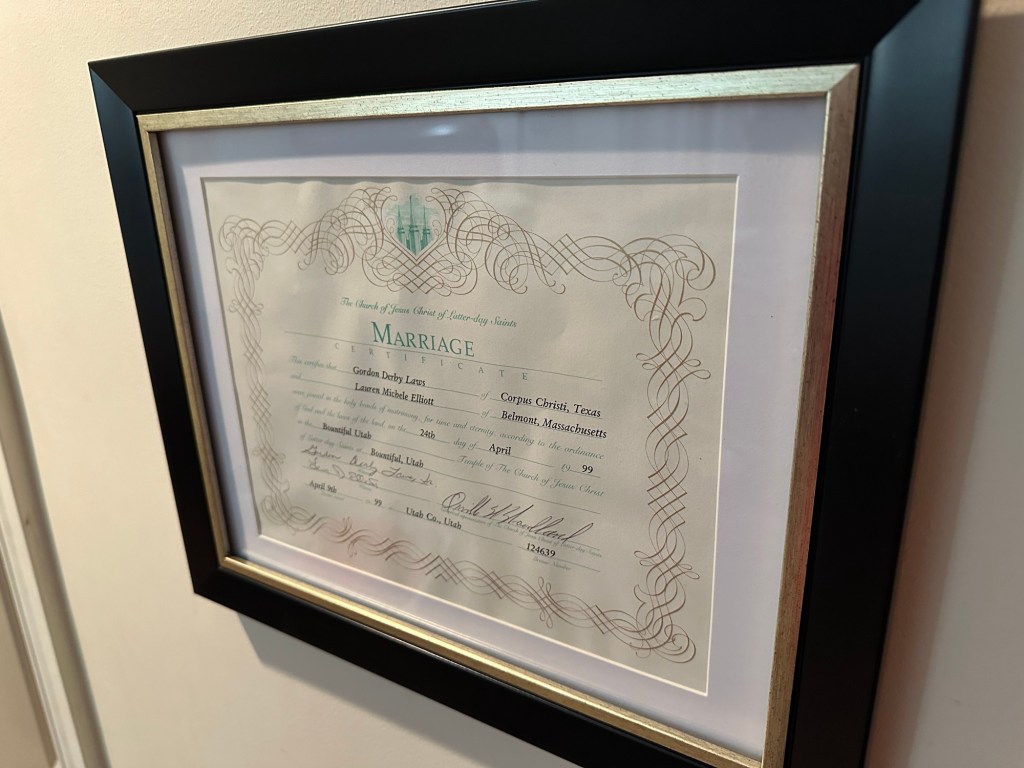
Naturally, this plays into all of Lauren’s worst fears. For years after our wedding, she had dreams that we hadn’t gotten married, and at least according to the certificate, she might be right. Or perhaps more accurately, she accidentally married my dad. Oof! That went a bad direction quickly . . . Anyway, my first legacy from my father is my name, which is legally and actually Gordon Derby Laws, Jr. And my second legacy is that, like my father, I can almost immediately see and read complexity into a situation that no one realizes is there; further, if one of us were to raise that complexity, everyone would be like, “Uh, that’s really no big deal” to which I say, “Well, it’s all fun and games until the credit ratings agencies mix you up for each other and your wife is legally married to your dad.” (Okay, that latter thing has never happened but the former has . . . also, dear Lauren, Grant, Lucia, Lindsay, and Graham, sorry for this troubling revelation in this way.) Like my dad, I’m usually able to calculate the importance of said complexity pretty quickly, sign the paper, and keep my mouth shut, realizing that the actuality of what happened overrides what the paper says.
Another legacy is the compulsion to write. This is more problematic because it is fraught with family history, advice, and resentments. My dad also liked to write. When he was fourteen, he spent a whole summer holed up in his bedroom writing a novel about pirates. His mother thought he had lost his mind and kept telling him to go outside and find stuff to do. He thought of pursuing the fine art of writing professionally, but his dad told him something to the effect of, “Write on your own time if you want, but writers make no money. Learn a real trade and get a real job first.” So he became a lawyer, then spent the rest of his life telling his kids not to become lawyers. (Of course, in the ever contradictory world of my father, he was highly irritated with the low regard people have for lawyers versus the high regard they have for doctors and he frequently groused that “lawyers were writing the Constitution while doctors were putting leeches on Washington’s backside.”)
Anyway, Dad’s novel . . . according to him, “It was really more of a novella, about ninety pages, and it wasn’t very good. I mean, I have a line in there about all the pirates going out on the town, and my character says, ‘I decided to stay behind and molest the women.’ Of course, I meant it in the Latin sense of the word molestar, which means to bother or irritate. I was totally tone deaf to the connotation. But you know, I think I could have been really good at writing. I just never got any encouragement. And now, I write all day, but I write legal briefs, which are as great to read as it is to watch paint dry.”
And herein lies the rub. My dad wanted to do for me what had not been done for him. So when I was young and started writing, he encouraged me and told me I could be anything I wanted to be. I got an electric typewriter for Christmas one year (yes, kids, before PCs became a thing). I wrote “books” (about eight to ten pages stapled together), and the librarians at the school library would put them in the stacks for kids to check out . . . and kids checked them out! Sometimes, the check out cards would get totally filled up and they would have to add new cards. What a rush!
The problem, of course, is that Grandpa Laws was right—writers don’t make money. When I got married, I told my in-laws I hoped to be a writer. I couldn’t understand why my mother-in-law kept running around telling everyone at our Boston wedding reception that I was “studying technical writing and editing and had a good job at BYU’s Independent Study.” It didn’t occur to me for at least ten years that my mother-in-law, who was then in Mitt Romney’s Church congregation, was terrified I would be one of these broke writers living in in-laws’ basements with a handful of academic publications, seven kids, and no way to pay for anything. And she certainly wasn’t about to tell the wealthy congregation she was in that I was on track to become that.
After I had my first kid, I was like a zillion other aspiring artists—I was working in publishing, getting paid through a bean blower, and trying to keep the dream alive on the side. I was about to apply to do a Master’s of Art in creative writing when I was standing in the copier room at Pearson Education and had a grand vision that said, “You make $28,000 per year right now. If you go to get this master’s degree, you will have $75,000 of debt and be qualified to make . . . $28,000 per year. This might not be the best idea.” I did not get a master’s degree in anything. On the advice of a mentor, I studied business like crazy on my own time and dime and sort of bootstrapped my way along to a fine life.
About ten years into my career, I did an analysis of book sales on published books—not including self-published books at all. The average published book in America from a major publishing house sells . . . wait for it . . . five hundred copies. At $30 per book with 10 percent going to the author, the average author can expect to make $1500 . . . after having lightning strike just to get the contract. So naturally, I spent the next decade saying, “Geez, Dad. Why did you encourage me to follow my dreams? That was not sound advice!”
Lucia is about to graduate. She has a topnotch accounting job lined up at a big-name firm. She has also shown the ability to write, but she spent her young life listening to her father say, “Nah, don’t pursue your dreams. Make your money, and then pursue your dreams. There’s no money in this writing nonsense unless you win the lottery, and since lotteries are a tax on people who can’t do math and you are not one of those people, I expect you will find something else.”
Now here I am at age forty-six writing this record every day. My mom wishes I would write the next Harry Potter. My wife wishes I would write just out of the love of writing and not be bothered about whether anyone reads or buys anything I write. But Dad, you and I know better, right? It’s way, way more complicated than that.
If you enjoy this, consider signing up to receive my free daily post. I recount the goings-on of the Laws in light-hearted fashion. It might be the one thing you read daily that makes you smile and think, “At least my life isn’t THAT.”
 His Smile Lit Up a Room and Other Things to Say at My Funeral
You’re a great writer Big Brother! I’m glad you’ve found this. I love reading your stories when my mind works well enough to. You’re the one who encouraged me to write. When I had my website about my kitty, you suggested a fictional page. I did it and called it The Not Necessarily True Adventures of Lilly Bug. Of course I decided to make it a prequel to the book series I’ve been working on for years, just five minutes each night. But you guided me in that too. You suggested that I read IT in order to get a better idea of the evil characters for my own book. Hopefully it’ll help as I do rewrites on the first story. Of course, I’m an unpublished writer. But you helped encourage me. I’ve enjoyed reading your stuff here when my brain can absorb it. It’s very good. But then you’ve always been good. I like what you said about Dad. He actually did start taking a creative writing course before he passed away. I’m not sure where but he did. So he didn’t really give up.
LikeLiked by 1 person